


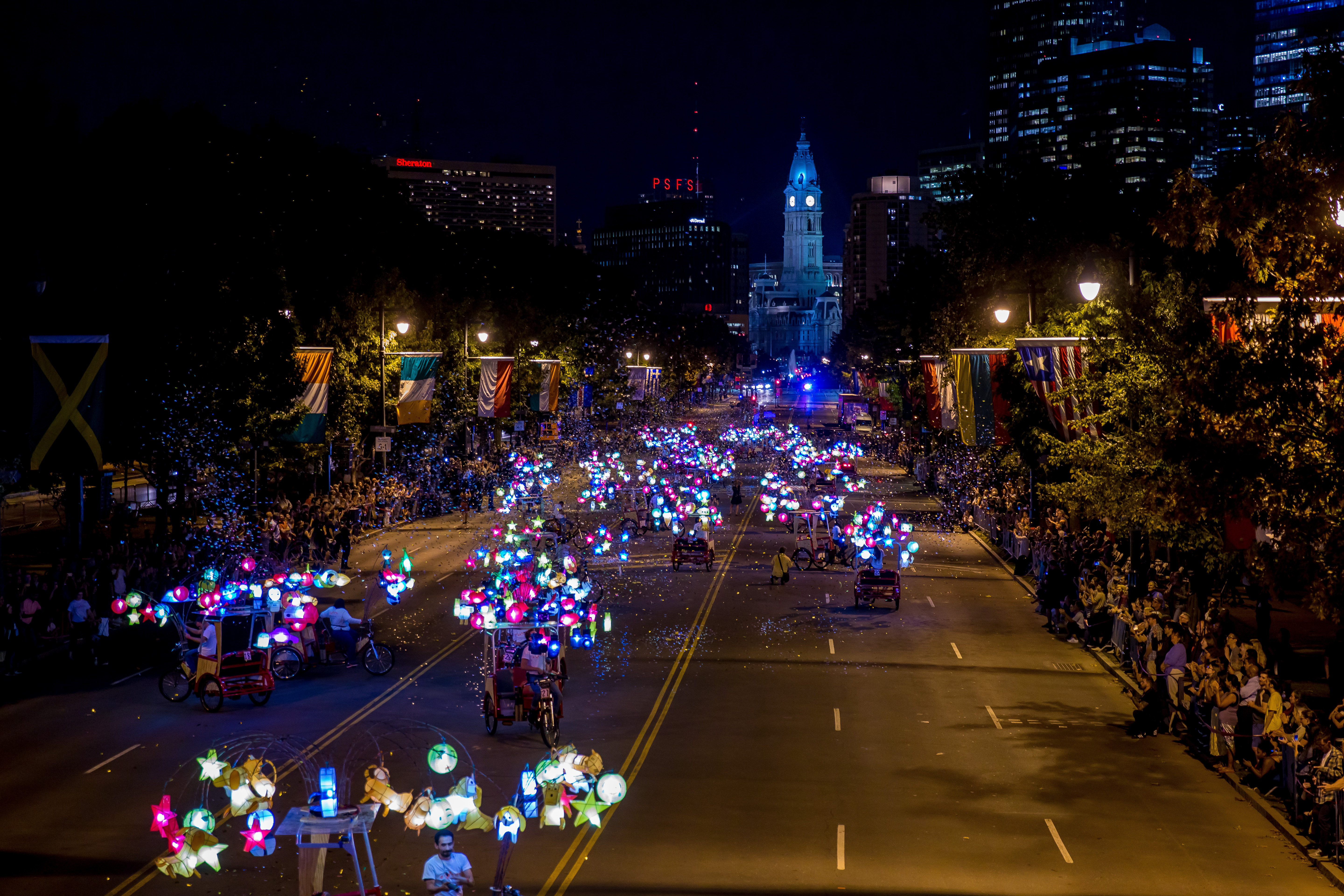
27 customized pedal vehicles festooned with over 900 handcrafted Chinese lanterns offered riders a moving public art experience along the Benjamin Franklin Parkway.
The power of public art in supporting democracy and debate
The concept of 'public assembly' might conjure images of demonstrations, debates or protests, but there are many reasons for citizens to come together, and art is an important one. Public art can be a catalyst and conduit for assembly -- as well as for discussion and debate. The Benjamin Franklin Parkway, home to some of the country’s premiere cultural institutions, also has a long history as a significant canvas for public art – and for civic engagement.
Institutions and their buildings tell layered stories about the history of a place. They take a long time to come into existence and are generally intended to last. They require a complex combination of political and public commitment, financial resources, land use considerations, and scale in relation to the type of entity housed within them, to name but a few of the challenges. This is particularly true on publicly owned property, such as the Benjamin Franklin Parkway, where many cultural institutions line a boulevard that was originally intended to bring the elegant design and celebrated public use of the Champs-Élysées in Paris to Philadelphia.
Over a hundred years ago, the Parkway was designed to create a contiguous link through the city proper, from City Hall on its east end, one mile to its terminus at Eakins Oval. The Fairmount Park Art Association (now the Association for Public Art, aPA) commissioned a comprehensive plan in 1907, designed primarily by architects Paul Cret and Jacques Gréber (who specialized in landscape architecture and urban design), and construction was completed in 1918.
Since then, the mile-long boulevard has served as more than a road to the huge cultural institutions that line it, but as a significant space unto itself.
From sanctioned celebrations like the country’s first Thanksgiving Day parade in 1919 to ad hoc gatherings like Be-Ins in the 1970s, to the 2020 Black Lives Matter protests, the history of cultural self-expression in Philadelphia, and the country writ large, can be traced through the types of gatherings taking place on the Parkway over the past 100 years. Many different forms of expression and celebration have found their way to the Parkway, with the Philadelphia Museum of Art as the backdrop, including athletic events like marathons and bicycle rides; the Gay Pride Parade; draft card burnings and protests of wars; the visit of Pope Francis I in 2015; sports and ethnic parades; concerts; and other expressions of celebration and government dissent. The public’s use of the Parkway documents the history of our right to gather under the First Amendment in the United States Constitution. No matter what the message, and how fragile that right may seem, its utilization has been and continues to be robust and diverse.
Philadelphia’s reputation as a place of excellence for learning and gathering is due, in part, to the Parkway’s internationally lauded cultural institutions. However, aside from a few outdoor artworks, one must enter a building and pay a fee to experience the extraordinary holdings of museums like the Philadelphia Museum of Art, The Rodin Museum, The Academy of Natural Sciences, Franklin Institute, The Barnes Foundation, and Calder Gardens, among others. This makes it difficult, if not impossible, for many people to share all that these institutions have to offer.
Public art, like Philadelphia’s iconic Love sculpture (1976) by Robert Indiana and the historic Swann Fountain (1924) by Alexander Stirling Calder, on the other hand, are available to all, without a ticket, enabling everyone to interact with art as an essential part of the human experience. According to the 2017 University of Pennsylvania SIAP Study about connecting art and well-being, art can also help reduce isolation and provide opportunities for real-time face-to-face dialogue and exchange as an antidote to our increasingly digitally focused culture.
Public Art, more specifically, animates physical sites where people find such a human connection. The artists who create these works offer us an exchange of ideas and the opportunity to discover new ideas and perspectives, or fresh approaches to an art form or a place. Bringing compelling art experiences to the public realm for free has been aPA’s mission for over 150 years. The Parkway has been a key site for both permanent and temporary works of art since 1929, when The Shakespeare Memorial was installed in front of the Free Library, fulfilling Jacques Gréber’s plan to punctuate the Parkway with works of art.
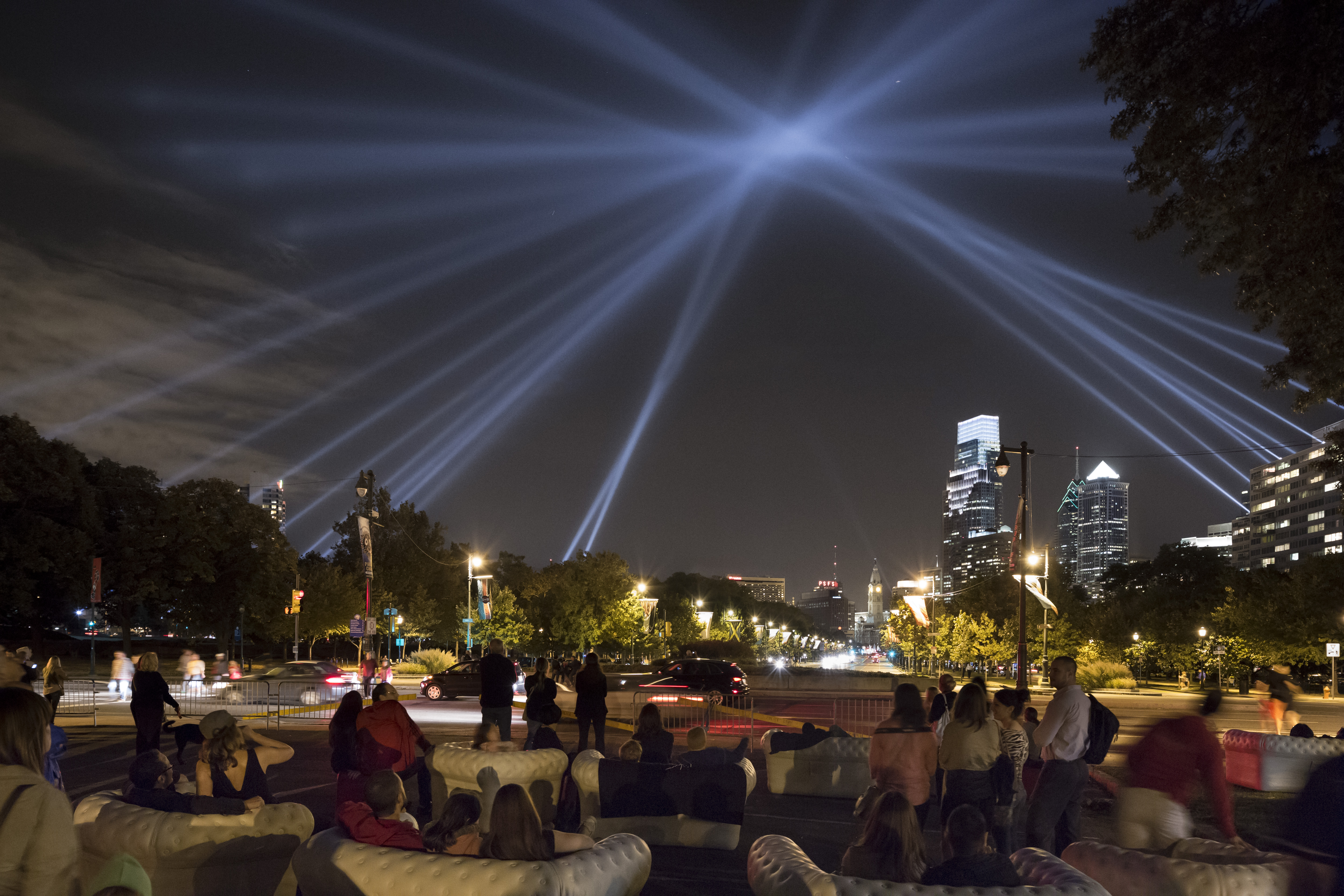
Some public art may ask viewers to actively participate, such as Rafael Lozano-Hemmer’s OPEN AIR commissioned by aPA in 2012. The artist offered the prompt, “Your Voice has the Power to Transform the Night Sky.” Using mobile technology, the artwork was an interactive light experience directed by participants’ voices and GPS locations, illuminating the night sky over the Parkway. Close to 6,000 messages were recorded in over 20 languages (including Russian, Portuguese, Hebrew, and Cantonese). Inspired by the city's rich tradition of democracy and respect for free speech, Open Air was created specifically for Philadelphia and for participation by the general public. An estimated 17,000 people visited the Parkway to experience the artwork that also included a “living room” at Eakins Oval for people to come together and view the light show at night when the Parkway is typically not active.
In recognition of the Parkway’s centennial anniversary, aPA commissioned Cai Guo-Qiang: Fireflies in 2017, a temporary artwork by internationally recognized artist Cai Guo-Qiang. Also presented at night, the public was invited to experience and travel the grand boulevard as a nocturnal dreamscape inside 27 customized pedal vehicles festooned with over 900 bobbing clusters of glowing handcrafted Chinese lanterns. The artwork concluded with over 5,500 free moon-lit rides along the Parkway throughout the four-weekend run of the project. Fireflies activated the public space and tapped into Philadelphia's egalitarian spirit and community pride to create a collective experience and was an exuberant example of art as an instigator for public gathering. Participants and viewers overwhelmingly agreed. One person commented on Instagram, “This is another reason why I love Philly! I love how people come together to work with each other and make art a joyful, memorable experience!” Another participant commented, “What a privilege to have art so accessible, approachable, and interactive for the public.”
In 2018, artist Jennifer Steinkamp’s Winter Fountains brought people together to experience art and beauty in public space. A four-month project launched in the winter months, Winter Fountains asked visitors to come outside and walk the Parkway to experience four animated large-scale architectural domes. Glittery by day, the domes glowed at night with interior projections drawn from Benjamin Franklin's explorations into electricity. This artwork combined art with science, past with future, and reflected the historic collections and connections of Philadelphia’s civic commons.
The City of Philadelphia’s Maja Park on the west side of the Parkway between 22nd and 23rd Streets is one of the Parkway’s newest public spaces. Established in 2021 and designed by landscape architect studio Ground Reconsidered, it encompasses 3.5 acres of unprogrammed passive recreation lawns, an allée of trees, and a paved pavilion with a pergola where concerts are held in the summer. The park’s name is drawn from Gerhard Marcks’ bronze sculpture Maja (1942; cast 1947), which was installed opposite the pergola by aPA as the focal point for the park. The creation of Maja Park is an example of a successful public-private partnership between AIR Communities (owner of the nearby apartment complex), Philadelphia Parks & Recreation (PPR), and aPA.
To further activate the public space in Maja Park, in 2024, aPA launched Art on the Parkway (AOTP), a temporary public art opportunity for Philadelphia area artists. In partnership with the Parkway Council and PPR, the AOTP commissioning program invites artists, designers, and other creatives to propose artwork that explores how art can respond to and encourage interaction with public space. This artistic activation and investigation comes on the heels of a Parkway redesign that aims to optimize the Parkway’s potential as an urban park–bringing people to the shared public space as a destination in itself.
Bar None by Philadelphia artist Nicolo Gentile was commissioned through AOTP in 2025. It honors the Parkway’s legacy as a site of collective public assembly and action. The installation was constructed with reclaimed steel barricades that were cut and welded together to create a continuous path-like structure that the viewer could walk alongside. It was interspersed with colored acrylic panels etched with images sourced from historic Philadelphia-based archives. The manipulated images reflected moments of protest, pride, and public gathering, exemplifying democracy in action. Bar None bears witness to the continuum of our national story, as told through public assembly, about who belongs and who has been left out.
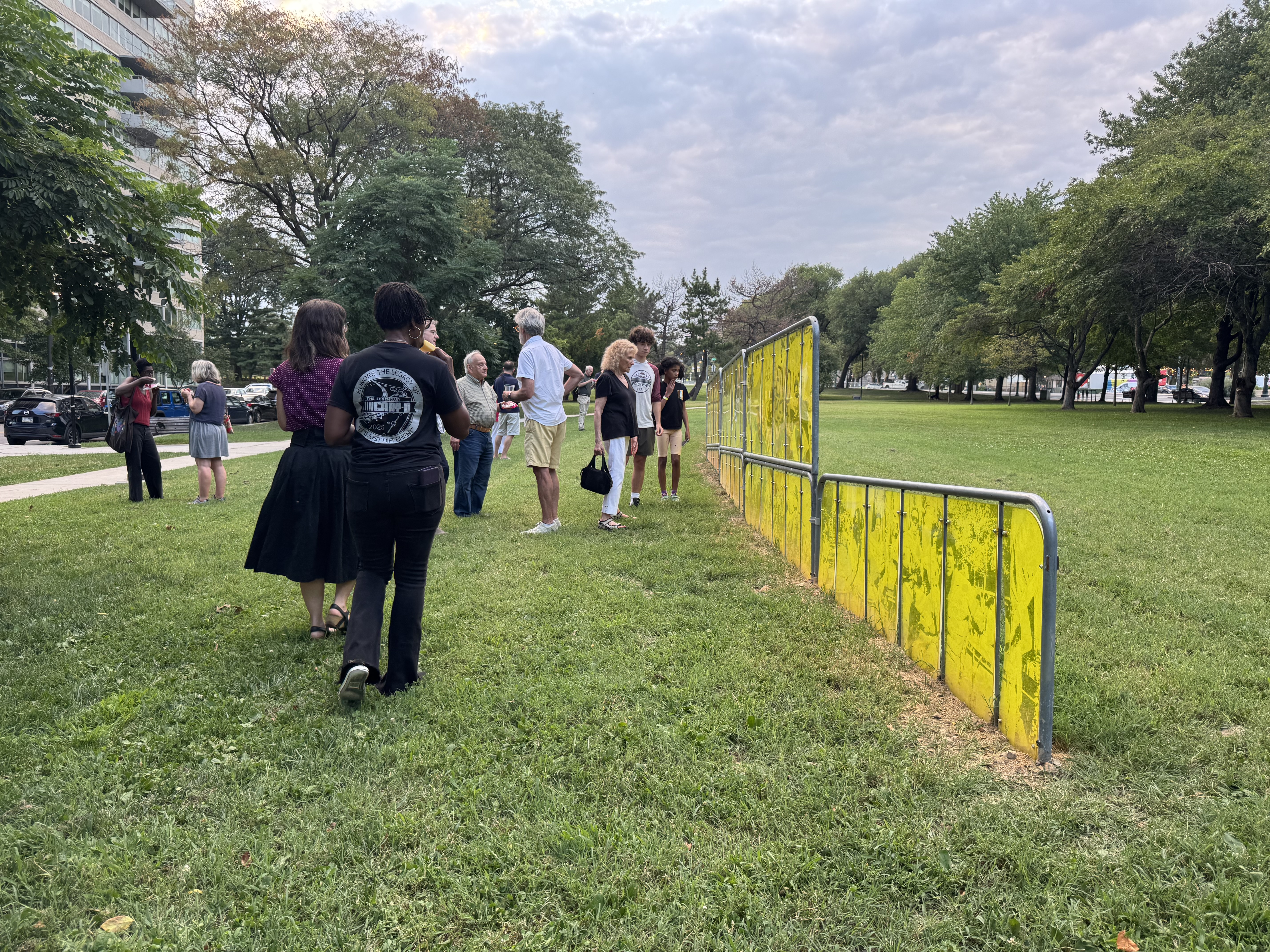
As Gentile describes, “The work doesn’t seek to commemorate a singular person, or even a singular movement. Instead, it offers a testament to the act of gathering itself—to the convergences, ruptures, celebrations, and solidarities that have defined this public space across time. And to that messy, sacred act of showing up together in public space and saying: this matters. We matter.”
“I wanted this work to hold tension,” Gentile further reflects. “To ask: What makes one gathering disruptive, and another civic pride? Why do we fear some bodies in public and celebrate others? How is resistance itself a kind of joy?” It became “a place where joy and resistance share the same ground.”
The public response to Gentile’s artwork highlighted the pleasure of being together in person in a civic space for the purpose of sharing memories and histories, exchanging stories about experiences, evoking past grievances and celebrations, and acknowledging that it is timely and important to make our voices heard by showing up in person. The artwork attracted local press attention – including Jeff Joseph Katz writing in William Way LGBT Community Center’s newsletter, “ At a moment when the digital can feel more real than the physical, Bar None asserts the irreplaceable nature of in-person gatherings. As the clouds of fascism affirm the need for and threaten the future of political assembly, Bar None asks: when else have we felt this way? How did we respond?”
In 2026, Art on the Parkway’s proposal prompt is Art as Catalyst, as we seek artworks that serve as a place for people with different backgrounds and perspectives to engage, encounter new ideas, and increase mutual understanding.
The Association for Public Art will be celebrating the Nation’s 250th anniversary in 2026 by presenting Let Freedom Ring, a monumental artwork by artist Paul Ramírez Jonas that features an interactive bell tower that plays the patriotic song “America (My Country, ‘Tis of Thee)” in its entirety, except for the final note. Passersby are invited to complete the unfinished song by playing that final note on a 600-pound look-a-like Liberty Bell, prompting them to reflect on what and for whom they ring this bell of freedom. The artist is “interested in how our national symbols are not static, but rather capable of transformation–just as our country was always meant to be.”
The artwork will be installed at Cherry Street Pier on the Delaware River waterfront–another site important to Philadelphia’s origins, and a public space that has been reimagined to bring people together to enjoy the river and experience a wide range of cultural and recreational activities.
Let Freedom Ring questions the very premise of our nation’s founding – how do we all participate in building a democratic union, one in which everyone’s voice is valued? What is each individual’s role and responsibility in this ongoing work, and how do we define freedom?
The Declaration of Independence’s 250th anniversary this year is a time to celebrate our right to assemble in public, as laid out in the Constitution’s First Amendment, ratified in 1788. The Benjamin Franklin Parkway is one of Philadelphia’s and our country’s most iconic and important sites that embodies this right of civic discourse. We cannot forget or underestimate the importance of gathering and having our collective voice heard in every city throughout America and the role public arts play in stimulating and inspiring those gatherings and voices.
Author note:
Charlotte Cohen is Executive Director of The Association for Public Art (aPA), which commissions and preserves public art in Philadelphia, while advancing the pivotal role art can play in creating and enhancing public space and civic life.
She has worked in the nonprofit cultural sphere and the public art field for over 30 years. Before joining the aPA, she directed Brooklyn Arts Council, where she designed and implemented the agenda and vision of Brooklyn’s foremost nonprofit cultural organization supporting artists.
As Fine Arts Officer and Urban Development Manager for the U.S. General Services Administration, Charlotte managed new commissions and the historic Fine Arts Collection in the New York City metropolitan region, across NY State, the Caribbean, and elsewhere.
She has served as Director of New York City’s Percent for Art Program, Department of Cultural Affairs; Project Director at the Smithsonian Institution’s Traveling Exhibition Service; and Program Director and Curator at Maryland Art Place.
Several aPA staff members contributed to this essay including Susan Myers, Julia Perciasepe, and Laura Griffith.


![William Penn portrait by Francis Place, Historical Society of Pennsylvania Treasures collection [1957.8], Historical Society of Pennsylvania.](/sites/default/files/styles/tile_xl/public/2026-05/270_large__1.jpg?h=e89ddd09&itok=-fci7H-O)


